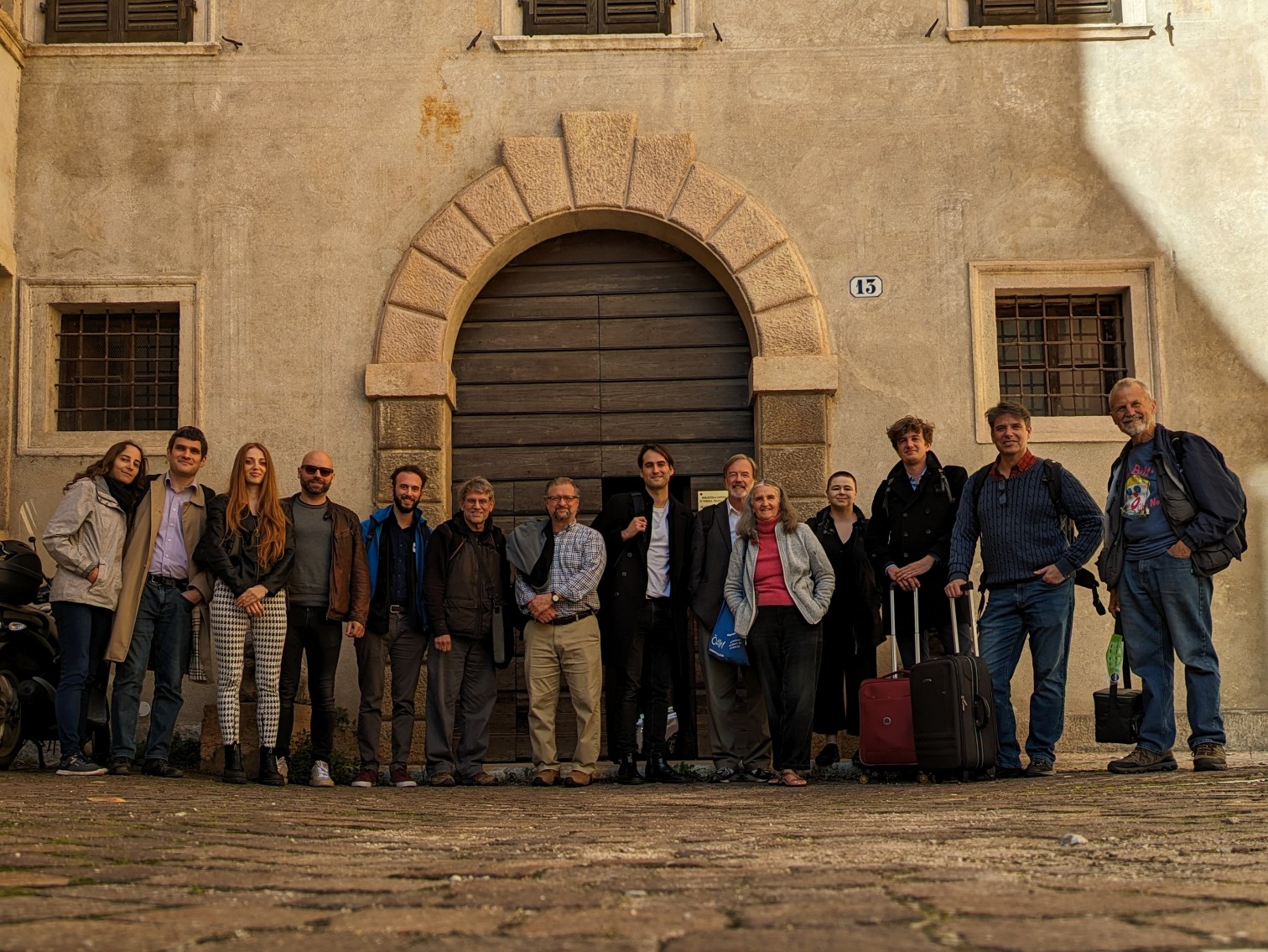
Palimpsests in Danger Project

2022-2024, Fondazione Biblioteca Capitolare di Verona ETS, Italy.

The “Palimpsests in Danger Project” tackles a critical challenge in manuscript studies: the severe damage inflicted upon thousands of palimpsests by 19th-century scholars. In their eagerness to recover erased undertexts, these early researchers often applied harsh chemical reagents, which, while sometimes effective in their time, permanently stained the parchment dark brown or black, obscuring much of the writing they sought to reveal. Today, these chemically treated manuscripts, housed in major libraries worldwide, are among the most valuable yet most severely compromised.

This ambitious 18-month pilot study, managed by the UCLA Library, the Early Manuscripts Electronic Library (EMEL), and the Fondazione Biblioteca Capitolare di Verona, aims to determine if and how the information on these endangered palimpsests can be recovered. It brings together a consortium of international experts and cutting-edge imaging techniques, including multispectral imaging (MSI), scanning micro-X-ray fluorescence spectroscopy (µXRF), and Optical Coherence Tomography (OCT). The project is designed in phases: an initial phase of data collection and comparison to identify best practices for imaging, followed by a second phase to test and refine these recommendations on a larger selection of folios.

The ultimate goal is to make the processed images from both phases widely available on the UCLA Library Digital Collections website, ensuring long-term accessibility and searchability for researchers globally. By leveraging modern scientific imaging, the “Palimpsests in Danger Project” represents a crucial effort to retrieve lost knowledge from these historically significant, yet chemically scarred, manuscripts, offering a potential last chance to decipher their hidden texts.

Project participants: The Lazarus Project (University of Rochester), Centre for the Study of Manuscript Cultures (CSMC), Nicolaus Copernicus University

Similar Projects

  • Cairo Geniza Fragments Spectral Imaging Project

    2015, Cambridge University Library. Coordinated by Judith Olszowy-Schlanger of the École Pratique des Hautes Études in Paris, in collaboration with Ben Outhwaite of the Taylor-Schechter Genizah Research Unit, the project applied cutting-edge spectral imaging and multidisciplinary materials’ analysis to the study of dozens of Genizah fragments. Some of the fragments were palimpsests, and others were…

  • Martellus Map Spectral Imaging Project

    2015, Beinecke Rare Book & Manuscript Library, Yale University. Funded by the National Endowment for the Humanities. The Martellus’ map, which dates to about 1491, is a highly detailed map of the then known world – reputedly studied by Christopher Columbus. “Multispectral imaging recovered more information than we dared to hope for,” says Chet Van…

  • Sinai Palimpsests Project

    2011-2016, St. Catherine’s Monastery of the Sinai, Egypt. A collaboration of EMEL, St. Catherine’s Monastery of the Sinai, and the UCLA Library to recover erased texts from the Monastery’s many palimpsests.  The project spectrally imaged 74 palimpsests (6,800 pages), identified 305 erased texts from Late Antiquity and the Middle Ages, and created world’s largest collection…

  • Sinai Library Digitization Project

    2018–present, St. Catherine’s Monastery of the Sinai, Egypt. A collaboration of EMEL, St. Catherine’s Monastery of the Sinai, and the UCLA Library to digitize the Monastery’s unparalleled manuscript library (including the New Finds) and publish the resulting images online with searchable metadata. Donors include the Ahmanson Foundation, Arcadia, the Steinmetz Family Foundation, and the Museum…

  • Paris Palimpsests Project

    2023, BnF, Paris France. The “Paris Palimpsests Project” is a collaborative initiative focused on the in-depth study and digital documentation of significant palimpsested manuscripts held at the Bibliothèque nationale de France (BnF). A key objective of this project was the comprehensive imaging and analysis of two primary manuscripts, Grec 2575 and Supplément Grec 257, alongside…

  • Vienna Palimpsests Projects

    2013-present, Austrian National Library, Vienna, Austria. EMEL is a long-term partner with the Austrian National Library and the Byzantine Research Division of Institute for Medieval Research, Austrian Academy of Sciences. EMEL provides spectral imaging and image processing to recover erased ancient texts on selected palimpsests. Funded by the Austrian Science Foundation. 2019 to present, the…