Author: Postmaster

  • XRF session in Hamburg

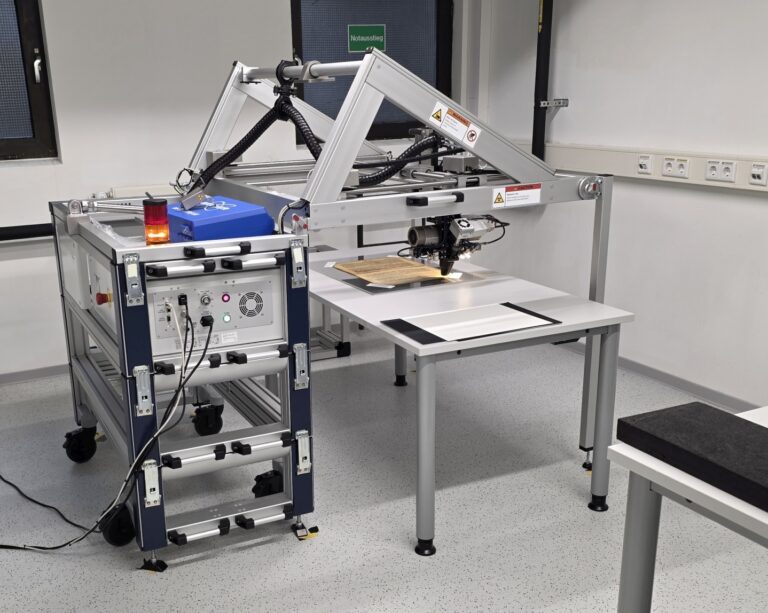
    EMEL collaborated with the Centre for the Study of Manuscript Cultures (CSMC) in a fascinating XRF data collection session in Hamburg (Germany), for the FWF funded project “The Vienna Basilica Palimpsests“. Imaging manuscripts using X-Ray Fluorescence (XRF) allows us to analyze a wide range of elements in an non-invasive approach, which assists our efforts in…

  • Successful Multispectral Imaging of Ancient Greek Palimpsests in Vienna

    A two-week multispectral imaging session recently wrapped up at the Austrian National Library in Vienna, successfully capturing invaluable data from numerous ancient and historically significant Greek palimpsest manuscripts (FWF funded project “The Vienna Basilica Palimpsests“) . A dedicated team of five experts, including skilled photographers, technicians, and image processing scientists, meticulously worked to image these…

  • Sinai Library Digitization Project

    2018–present, St. Catherine’s Monastery of the Sinai, Egypt. A collaboration of EMEL, St. Catherine’s Monastery of the Sinai, and the UCLA Library to digitize the Monastery’s unparalleled manuscript library (including the New Finds) and publish the resulting images online with searchable metadata. Donors include the Ahmanson Foundation, Arcadia, the Steinmetz Family Foundation, and the Museum…

  • Vatopedi Palimpsests Project

    2024–present, Vatopedi Monastery, Mt. Athos, Greece. The “Vatopedi Palimpsests Project” is a pioneering collaboration between the Holy Vatopedi Monastery, the UCLA Library, and the Early Manuscripts Electronic Library (EMEL); with the participation of Aristotle University of Thessaloniki. This ambitious initiative aims to systematically study and digitally recover the hidden texts within all palimpsest manuscripts housed…

  • Palimpsests in Danger Project

    2022-2024, Fondazione Biblioteca Capitolare di Verona ETS, Italy. The “Palimpsests in Danger Project” tackles a critical challenge in manuscript studies: the severe damage inflicted upon thousands of palimpsests by 19th-century scholars. In their eagerness to recover erased undertexts, these early researchers often applied harsh chemical reagents, which, while sometimes effective in their time, permanently stained…

  • Paris Palimpsests Project

    2023, BnF, Paris France. The “Paris Palimpsests Project” is a collaborative initiative focused on the in-depth study and digital documentation of significant palimpsested manuscripts held at the Bibliothèque nationale de France (BnF). A key objective of this project was the comprehensive imaging and analysis of two primary manuscripts, Grec 2575 and Supplément Grec 257, alongside…

  • Sinai Palimpsests Project

    2011-2016, St. Catherine’s Monastery of the Sinai, Egypt. A collaboration of EMEL, St. Catherine’s Monastery of the Sinai, and the UCLA Library to recover erased texts from the Monastery’s many palimpsests.  The project spectrally imaged 74 palimpsests (6,800 pages), identified 305 erased texts from Late Antiquity and the Middle Ages, and created world’s largest collection…

  • Vienna Palimpsests Projects

    2013-present, Austrian National Library, Vienna, Austria. EMEL is a long-term partner with the Austrian National Library and the Byzantine Research Division of Institute for Medieval Research, Austrian Academy of Sciences. EMEL provides spectral imaging and image processing to recover erased ancient texts on selected palimpsests. Funded by the Austrian Science Foundation. 2019 to present, the…

  • Codex Zacynthius Spectral Imaging Project

    2018-2020, Cambridge University Library, Cambridge, United Kingdom. A collaboration of EMEL, Cambridge University Library, and the Institute for Textual Scholarship and Electronic Editing at Birmingham University. The project is led by Professor David Parker (Principal Investigator) and Dr Hugh Houghton (Co-Investigator) and is funded by an Arts and Humanities Research Council Research Grant. The erased…